
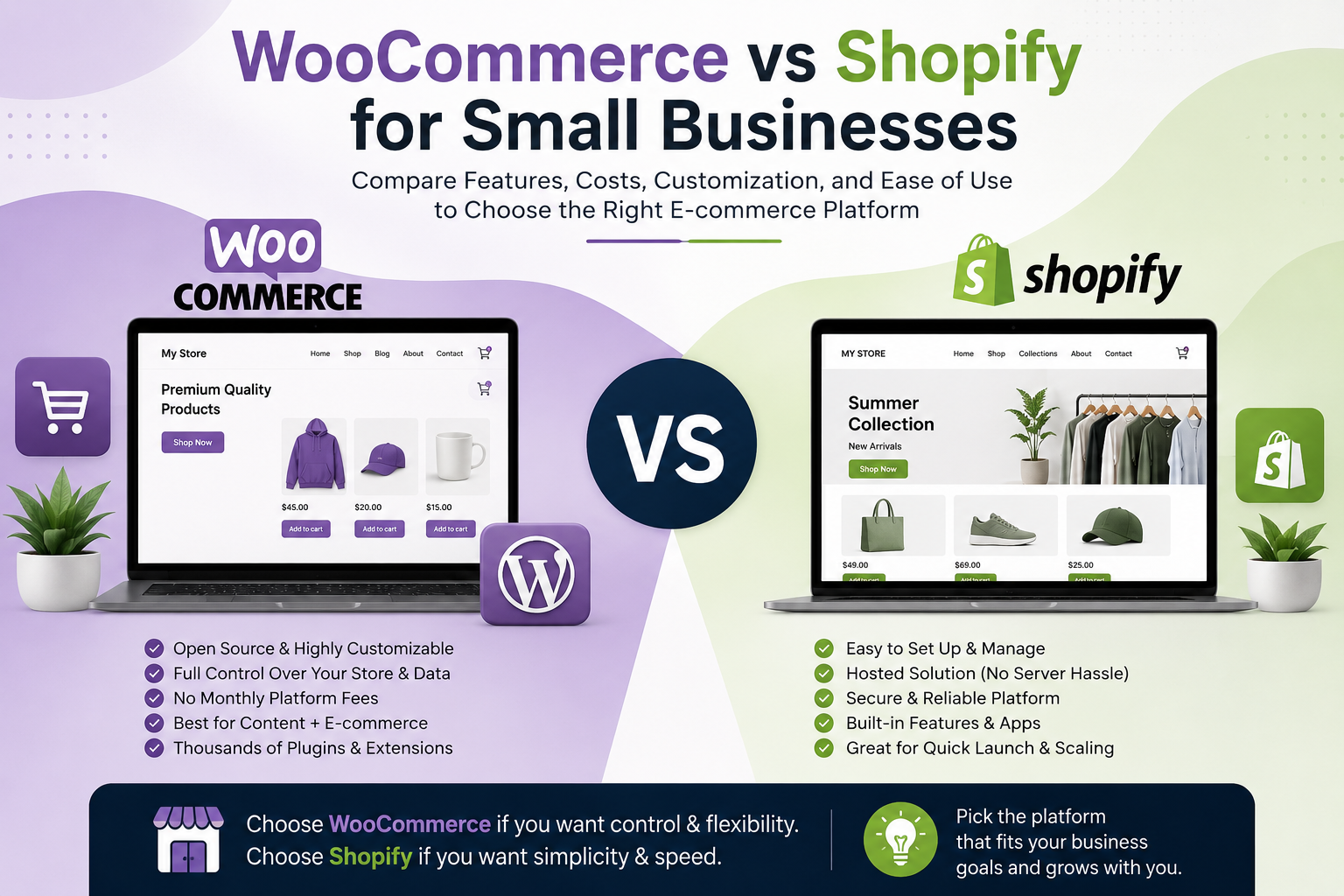
WooCommerce vs Shopify for small businesses is a common comparison because both platforms can build a professional online store, but they work in different ways. Shopify is a hosted platform that keeps setup and maintenance simple, while WooCommerce is an open-source WordPress solution that gives store owners more control. The right choice depends on your budget, technical confidence, design needs, and plans for growth. WooCommerce officially describes its platform as open source and built for self-hosted WordPress websites.
Ease of Setup
Shopify is usually easier for beginners. Hosting, platform updates, and the main store infrastructure are managed for you. After choosing a plan, you can select a theme, add products, connect payments, and configure shipping. Shopify also provides TLS certificates for domains connected to a store.
WooCommerce requires more setup. You need WordPress, hosting, a domain, and the WooCommerce plugin. The core software is free and open source, but you are responsible for your hosting and website maintenance. This takes more time, although it also gives you greater freedom over how the store is built.
WooCommerce vs Shopify Cost for Small Businesses
Shopify uses a subscription model. Plans include different features, card rates, and third-party transaction fees, and prices can vary by country and billing cycle. Premium themes and paid apps may increase the monthly cost.
WooCommerce does not charge a monthly fee for the core plugin. However, you still need hosting, a domain, security, backups, and possibly paid extensions or developer support. A simple WooCommerce store can be affordable, but a heavily customized store may cost more to build and maintain. WooCommerce offers both free and paid extensions for adding store functionality.
Shopify is often easier to budget for at the beginning. WooCommerce can offer better long-term flexibility when hosting, plugins, and development costs are managed carefully.
Design and Customization
WooCommerce offers strong design freedom because it works inside WordPress. You can create custom layouts, edit templates, build content-rich pages, and add unique functionality without being tied to a closed platform.
Shopify themes can also be customized through theme settings, custom sections, and Liquid development. For many small stores, this provides enough flexibility. More advanced changes may require a developer, and some features may depend on paid apps. Shopify supports both public and custom apps for extending store functionality.
Choose WooCommerce when full design and code control matter. Choose Shopify when you want a structured system that is simpler to manage.
Payments, Shipping, and Store Features
Shopify supports its own payment services in eligible regions and also allows third-party payment providers. Depending on your plan and selected provider, additional transaction fees may apply.
WooCommerce supports many payment gateways and extensions. Store owners can select their preferred payment provider, shipping tools, checkout options, and integrations. WooPayments supports cards, digital wallets, automated payouts, and multi-currency features in supported countries.
Both platforms can manage products, discounts, shipping, customer accounts, and orders. The main difference is whether you prefer built-in simplicity or deeper control.
Maintenance and Security
Shopify manages hosting, core platform updates, and much of the technical infrastructure. This suits business owners who do not want to handle regular website maintenance. Secure TLS connections are also provided for domains added to Shopify.
With WooCommerce, you manage WordPress updates, themes, plugins, backups, and hosting. A properly maintained WooCommerce store can be secure and reliable, but outdated software or weak hosting can cause performance and compatibility problems. WooCommerce publishes specific server recommendations to help store owners choose an appropriate hosting environment.
WooCommerce vs Shopify for Content and SEO
WooCommerce is a strong choice for businesses that depend on blogging, service pages, guides, and content marketing because it is built on WordPress. It offers detailed control over page layouts, URLs, plugins, and content structure.
Shopify includes blogging and SEO features that are sufficient for many small businesses. It is easier to manage, although WordPress usually provides more flexibility for advanced content strategies.
Which Platform Is Better for Your Small Business?
Choose Shopify when you want to launch quickly, prefer predictable monthly billing, and do not want to manage hosting or software updates. It works well for product-focused businesses that value simplicity.
Choose WooCommerce when you already use WordPress, need greater customization, want control over your hosting and data, or plan to combine e-commerce with a content-heavy website. It is especially useful for stores requiring custom pricing, memberships, bookings, or complex integrations.
Final Thoughts
There is no universal winner in the WooCommerce vs Shopify for small businesses debate. Shopify is generally easier to operate, while WooCommerce provides greater ownership and flexibility.
Before choosing, list the features you need now, the integrations you may need later, and the amount of technical maintenance you are willing to handle. The best platform is the one that supports your business without adding unnecessary cost or complexity.